

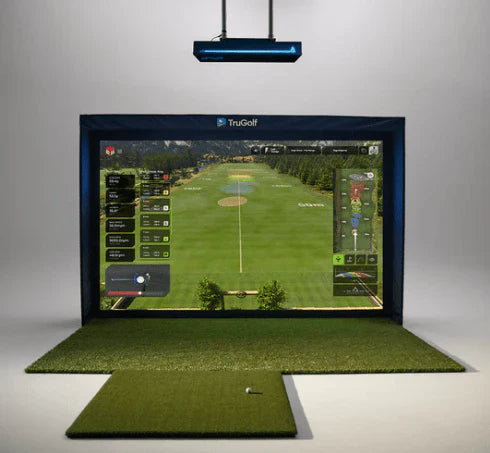
If you’ve ever hit a “perfect” 7-iron on a simulator and thought, “That doesn’t look like my real distance,” you’re not alone. Accuracy is one of the biggest questions golfers ask before buying a simulator, or after a few sessions when the numbers don’t match what they expect outdoors.
The honest answer is that golf simulators can be extremely accurate, especially on full swings, but the result you get depends on three things: the quality of the launch monitor, how well the setup is dialled in, and what type of shots you’re hitting.
A great simulator isn’t just about matching a perfect outdoor number once. It’s about giving you reliable feedback you can trust, session after session, so you can practise with confidence, especially through a Canadian winter.
What “Accuracy” Means In A Golf Simulator
When golfers say “accurate,” they usually mean one of two things.
The first is: “Does it match what I see on the course?” That’s the outdoor comparison. The second is: “Can I trust it to help me improve?” That’s consistency and feedback.
A simulator’s “accuracy” is also a mix of two kinds of information: measured data and modelled data.
Measured data is what the launch monitor actually detects when you strike the ball. This typically includes things like ball speed, launch angle, launch direction, and often spin or spin-related metrics. Some systems also capture club delivery data, like club path, face angle, and attack angle.
Modelled data is what the software calculates after the strike, ball flight, landing angle, roll, bounce, and total distance. That modelling is usually very good, but it’s still a simulation. It depends on settings like altitude, wind, temperature assumptions, turf firmness, and how the software treats “normalization.”
This is why two sims can show slightly different totals for the same shot even when the measured launch conditions are similar.
Accuracy Vs Consistency
If you’re using a simulator to get better, consistency matters even more than a perfect match to your local course.
A sim can be slightly different from your outdoor distances and still be a great training tool, because it’s repeatable. When the numbers are stable, you can track changes in launch, spin, and carry over time. That’s what builds improvement.
If you want one key takeaway: trust carry distance and launch conditions first, and treat total distance as more “environment-dependent.”
Typical Accuracy Expectations By Simulator Tier
Not all simulators are built the same. The best way to set expectations is to think in tiers and shot types.
Premium Systems
High-end systems, often the ones used in fittings and high-performance environments, tend to deliver very tight results on full swings. When people say premium sims are “within a few percent,” what they mean in practical terms is that a well-struck shot is typically very close to what you’d expect outdoors for carry, launch, and ball speed.
That doesn’t mean they’re magic. It still depends on setup, environment, and what you’re comparing against. But for full shots, premium systems can feel very close to “real golf” when the bay is built properly.
Mid-Range Home Systems
This is where most serious home golfers land. In this tier, accuracy can still be excellent on full swings, but the setup matters more. A slightly off alignment, inconsistent ball placement, or a poor hitting surface can create bigger differences than the monitor itself.
A mid-range system in a well-planned room often performs better than a premium system in a poorly set-up room. The bay matters.
Entry-Level / Portable Units
Budget and portable units can still be extremely useful, especially for practice and trends, but they’re more sensitive to environment.
This is where you’ll most often see bigger variability on:
very short shots
low-speed chips
spin-heavy wedge shots
putts and delicate rollouts
That doesn’t make them “bad.” It just means they’re better used as practice feedback tools than as perfect replicas of outdoor golf.
The Biggest Factors That Change Accuracy
Two golfers can use the same simulator model and get different results. That’s usually because of setup, environment, and shot type, not because one golfer is “doing it wrong.”
Here are the factors that matter most.
Radar Vs Camera Technology
Radar-based monitors track the ball through flight. They can be excellent outdoors and work well in large indoor spaces, but they often prefer more ball flight to gather clean data.
Camera-based (photometric) monitors capture impact conditions with high-speed imaging. Indoors, this approach can feel very stable because it doesn’t rely on the ball travelling a long distance.
Neither is automatically superior. The best choice depends on your space and how you use the sim. But if someone says “my radar unit feels different indoors,” it’s usually because the space is tight, alignment is off, or there isn’t enough consistent flight.
Setup Quality: Alignment And Level
Accuracy starts with geometry. If the unit is slightly misaligned to your target line, you can get strange start lines and shot shapes that don’t match your intent.
If the monitor or hitting area isn’t level, launch and spin relationships can look odd. Even small differences matter when you’re measuring at impact.
The simplest routine is to set your hitting position and ball placement in the same spot every time, then re-check alignment anytime something changes in the room.
Environment: Lighting, Interference, And Background
Camera systems care about lighting. Inconsistent lighting can cause occasional misreads, especially for certain balls and surfaces.
Radar systems can be affected by room features, reflective surfaces, or objects in the tracking path. A clean, consistent environment helps both types perform better.
The Mat Effect: Why Indoors Can Feel “Different”
This is one of the most important points, and most people don’t hear it until after they’ve bought a sim.
Hitting off a mat can change how the club interacts with the ground. On real turf, a steep strike can dig. On a mat, the club may bounce or skid. That can alter strike location, dynamic loft, and spin in ways that affect carry and ball flight.
It can also change how you swing. Some golfers subconsciously protect their wrists or elbows on firm mats, which changes delivery. That shows up in the numbers.
This doesn’t mean simulators are inaccurate. It means indoor golf is a slightly different environment. A better mat and consistent technique reduce the difference.
Balls, Markings, And Wear
Using different balls can lead to different results, especially with spin-heavy shots.
If you want your simulator to feel consistent, use one or two known balls in good condition for your practice sessions. If your ball is scuffed or dirty, spin and launch readings can drift.
You don’t need to overthink this. Just keep it consistent.
Where Golf Simulators Are Most Accurate
Most simulators perform best when you give them a clean, fast strike and a full ball flight model to work with.
Full Swings With Irons And Driver
Full shots are the strongest use case. That’s where the launch monitor has the most information to work with, and where the shot is fast enough to be captured cleanly.
If your simulator is set up well, full shots tend to be the most reliable place to trust:
ball speed
launch angle
launch direction
carry distance
If you’re comparing to outdoors, carry is the cleanest number to compare. Total distance depends more on modelling assumptions.
Club Data: Most Useful When Repeatable
If your system captures club data, it can be incredibly useful for improving. But club data is often more sensitive to consistent setup.
If you move your ball position around, change tee heights, or vary your stance dramatically, club numbers can look “off” even if the monitor is doing its job.
The goal is to create a repeatable station. Then the club data becomes powerful.
Where Simulators Can Be Less Reliable
Even the best setups can show limitations. It’s better to know these up front so you use the simulator intelligently.
Wedges, Chips, And Partial Swings
Short shots are harder because the ball speed is low and the strike is more delicate. Small differences in contact, ball position, and mat interaction create big differences in spin and launch.
This is where golfers most often say, “My wedge numbers don’t match outside.” That can be true, especially for partial shots.
The solution isn’t to abandon wedge practice indoors. It’s to practise differently:
focus on carry windows rather than exact totals
use the same ball type and a consistent strike area
treat partial wedges as a “pattern training” session
If you can hit a 40-yard carry window consistently indoors, that skill transfers.
Putting
Putting is the most variable part of simulator golf. It depends heavily on the putting surface, how the sim reads the roll, and the software settings.
Some setups make putting feel close. Others feel like a game mechanic. Neither is wrong, it’s just the nature of sim environments.
A practical approach is to treat putting as “playable” rather than “perfect,” unless you have a dedicated putting solution designed for realism.
A Simple Calibration Mindset That Works
If you want to get the most value from your simulator, don’t chase a perfect match to one outdoor session. Build a baseline and measure improvement.
Use Carry As Your Main Distance Number
Carry is the most direct and useful distance number for indoor training. Total depends on simulated turf, landing angle modelling, and settings.
If your carry distances are consistent, you’re getting valuable feedback.
Build Your Own Indoor Yardage Chart
Pick your stock clubs and hit a controlled sample size. Track the average carry and launch pattern.
Then use that as your indoor baseline. Over the winter, you can watch how your numbers change. When spring arrives, you can confirm outdoors and adjust if needed.
This approach keeps the simulator useful even if your outdoor ball reacts differently on real grass.
If Your Simulator Numbers Look Off, Check These First
You don’t need to become a technician to dial in a simulator. Most issues come from a few repeatable causes.
Here’s a simple diagnostic flow.
1) Re-Check Alignment And Level
If the unit is slightly off target line, shot shapes can look exaggerated. If the hitting area is uneven, launch conditions can change.
Start here because it’s the fastest fix.
2) Make Ball Position And Tee Height Consistent
Tiny differences in position matter, especially for wedges and driver tees. Choose one ball spot and stick to it.
If your driver numbers seem unusual, check tee height first. A higher tee can change launch and spin significantly.
3) Stabilize The Environment
If you have a camera-based unit, keep lighting consistent. Avoid harsh flickering or changing brightness between sessions.
If you have a radar-based unit, remove anything that could interfere with tracking, and confirm you have enough ball flight distance for the unit to read cleanly.
4) Check The Mat And Strike Area
If the mat is worn, uneven, or too firm, it can change strike and spin. If you’re hitting slightly behind the ball on a firm mat, the mat can “save” the shot in a way turf wouldn’t.
A better mat and consistent strike point often improve realism and comfort at the same time.
5) Confirm Software Settings
Some software settings can change what you see on screen:
altitude
wind
firmness
“boost” or normalization settings
If your numbers look unusually long, check settings before you assume the monitor is wrong.
Why Consistency Wins In Winter
Canadian simulator setups often live in garages and basements. That means temperature swings, multi-use rooms, and less “studio perfect” environments.
In these spaces, chasing a perfect outdoor match can be frustrating. A better approach is to make your indoor setup consistent and comfortable, then use it as a winter training tool.
If your simulator is stable and repeatable, you’ll improve faster because you practise more. The best simulator is the one you actually use through the winter.
For garage setups, comfort matters. If your hands are cold and your body is stiff, your swing changes. Even a modest heating plan can make winter sessions feel more like real golf.
How PinPoint Golf Sims Helps You Get Accurate Results
At PinPoint Golf Sims, our focus is making indoor golf shopping easier, smarter, and more accessible for Canadians.
Accuracy doesn’t come from one product alone. It comes from the whole system working together: the right launch monitor for your space, a hitting surface that feels good, a screen or net that fits your room, and a setup plan that reduces friction.
That’s why we put so much emphasis on compatibility and practical planning, especially for home users, DIY builds, training professionals, and golfers upgrading existing simulators.
If you’re not sure why your numbers look off, it’s usually not a mystery. It’s one or two setup issues that can be fixed quickly. If you share your room size and how you’re set up, we can help you troubleshoot and point you toward the right upgrade path.
FAQs
Are Golf Simulators Accurate Enough To Trust For Distances?
For full swings, many simulators provide very reliable carry distance and launch conditions when set up properly. Carry is the best number to trust and track over time.
Why Do My Simulator Distances Differ From The Course?
Differences usually come from mat interaction, software settings, indoor environment, and the fact that total distance is modelled. Outdoor conditions, turf, and wind also change real distances.
Are Premium Systems More Accurate Than Budget Units?
Premium systems generally offer tighter consistency and better performance across more shot types. Budget units can still be excellent for practice and trends, but they’re often more sensitive to setup and short shots.
Do Golf Mats Affect Spin And Distance?
Yes. Mats can change ground interaction and strike dynamics, especially for steep swings. A better mat and consistent strike point can reduce the difference.
Are Radar Or Camera Launch Monitors More Accurate Indoors?
Both can be accurate indoors, but camera-based systems often feel more stable in shorter spaces. Radar units tend to prefer more ball flight and clean alignment.
How Accurate Are Golf Simulators For Wedges And Chips?
Short shots can show more variation because speeds are lower and mat interaction matters more. Practising carry windows and consistency indoors is still very valuable.
How Accurate Is Putting On A Golf Simulator?
Putting accuracy varies widely by setup and software. Many golfers treat putting as “playable” for rounds and focus practice time on full shots and short-game carry control.
What Should I Check If My Numbers Look Boosted?
Start with software settings (altitude, wind, normalization), then re-check alignment, ball position, and tee height. Those are the most common causes of inflated distance.

Share:
Best Golf Simulator In Canada: How To Choose Yours
Golf Simulator Room Size Guide: How Much Space Do You Really Need?